Home is where the shop is

Most of our posts center on Gypsy. Well, much of this last weekend was spent in the garage making parts. If you have been following our blog for a while you will notice that our garage is a far cry from the shop we were working in last year. Not to complain since we were out of the rain, but parkas are required protective gear. It is also sort of crowded in there and the light is dim.

shop
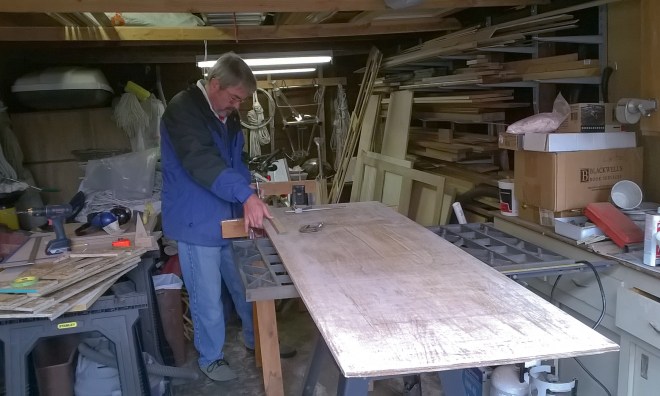
Bill is marking out the door openings on the port settee back.

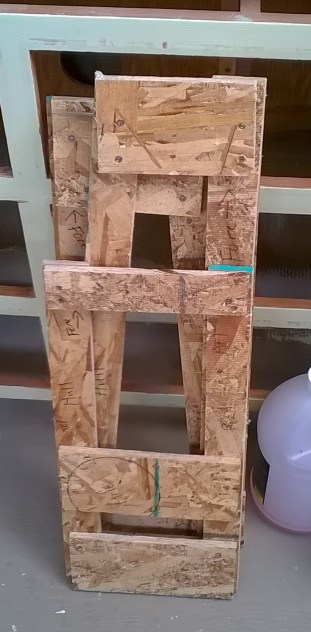
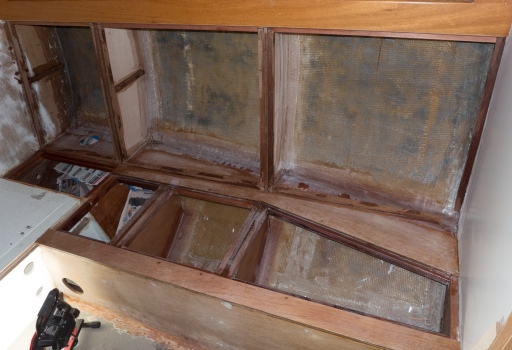
We worked on the settee backs cutting out the door openings. We also cut out the shelves that will go into the settee backs. You can see the templates for the shelves on the saw horse at the bottom left of the photo.

We have been using a guide with the sabre saw to keep the cuts straighter.

Sabre_saw
Guide clamped to the plywood. The saw is definitely vintage. It is at least 50 years old.

While Bill was making saw dust, Nina was cutting out vinyl to go over the foam in the lockers. Nothing better to give your house that new car smell.  Gluing it in is next week’s project. Right after the bunny and the ham.

Back to the boat

We are back in the land of cold and wet.  And back working on Gypsy, plugging away for that day when we, too, can head down the Columbia and hang a left.

Here’s what we’ve been working on.  Holed up in the garage, Bill has been coating the settee seat backs with epoxy.  They are now sanded and we’re waiting for decent weather to cut the openings and doors trim them with hardwood.

Pantry
The pantry now has all its insulation in place and it has been covered by vinyl. We discovered that the vinyl we had was pretty beige compared to our white paint, so we made a trip down to our local foam store and bought a bright white for covering the rest of the insulation in the main cabin. 

While Bill was making templates for the settee locker shelves, Nina was insulating drawers.

galley
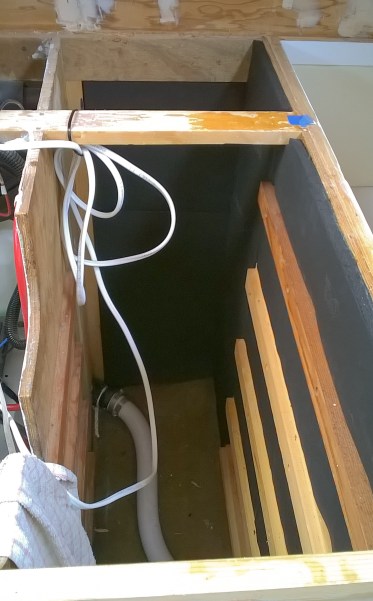
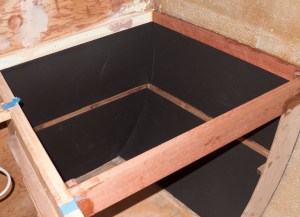
Black foam everywhere in the galley drawer bank, except for the floor. That will be covered later, once we figure out wiring and any plumbing that will need to go in that space.  The foam will help minimize condensation when it’s cold out and with noise reduction when the engine is running. We’re going to leave it un-vinyled.  To the left of the red wire on the left is the engine. We’ll be insulating that panel on the engine side to help deaden engine noise.  It may seem like overkill, but the interior of the boat is a small space with many hard surfaces that sound can reverberate through.


Shelf_templates

Bill’s shelf templates for the settee back lockers.  They looked like this when they were waiting to go home. The lockers will get covered in the new white vinyl before we add the shelves and seat backs.

Our last project of the weekend was to think about how we could better use the space where the house bank of batteries lives.  Bill made a box for them years ago when we first bought Gypsy.  Looking at it now, we realized we needed to add accessible switches and fuses to them.  The easiest way to do this is to move the box.  If we shift it over a couple of inches, we’ll have access on both sides of the box, and it won’t be a complicated project.  Now’s the time to do it.

batteries
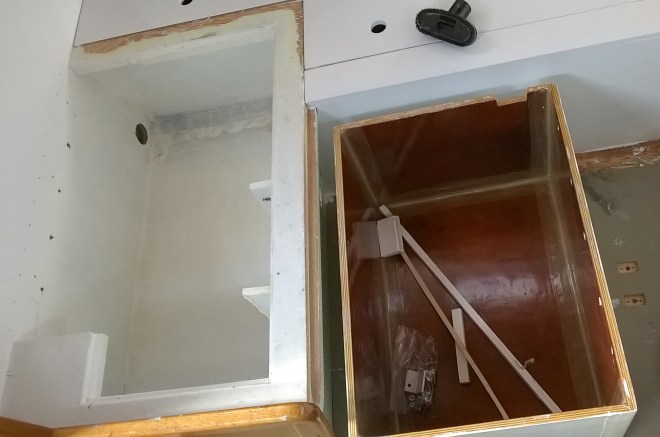
The house bank is its current location. The idea is to move it to the left a couple of inches, reconfigure the lid (which was sticking anyway) and improve access to the right side of the box for wiring and switches.  The left side will get a new access panel and a new switch as well.
battery_box
Battery box out of the settee.  It came out easily and will be easy to relocate.  Meanwhile, we can touch up the paint in and around the locker.


Test trip to Mexico

We have been working away on Gypsy for quite awhile now with the idea of heading off to the wild blue yonder once we are done. Well, in the back of our minds the question has been forming, what if it’s too hot? The Pacific Northwest does not suffer from excesses unless we are talking about rain, so we don’t know what hot weather is like. The only solution was to take a trip to the tropics.

Puerto Vallarta came to mind. Our friends Randy and Ruth would be there on Velic doing final prep before they headed off to the Marquesas and it would be hot. We got tickets.

marina
The view of Marina Vallarta from our room in the Flamingo Vallarta hotel. Palm trees and mega yachts.

We did some sight seeing. Riding the bus into town is a great part of the adventure.

Ruth_Randy_Nina
Ruth, Randy and Nina on the Malecon.
malicon
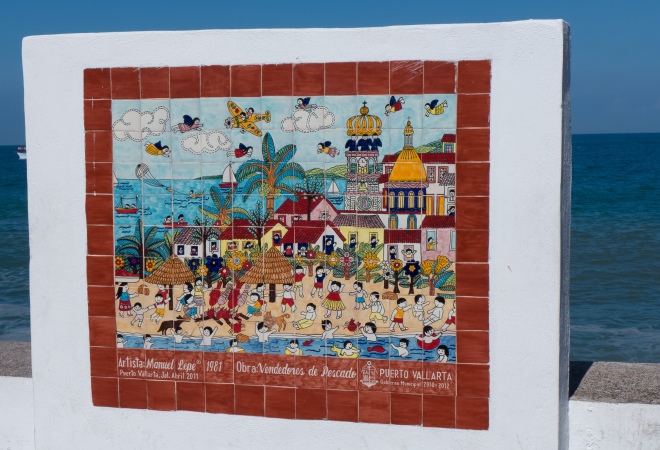
There were many sculptures on the Malecon.
helpful_map
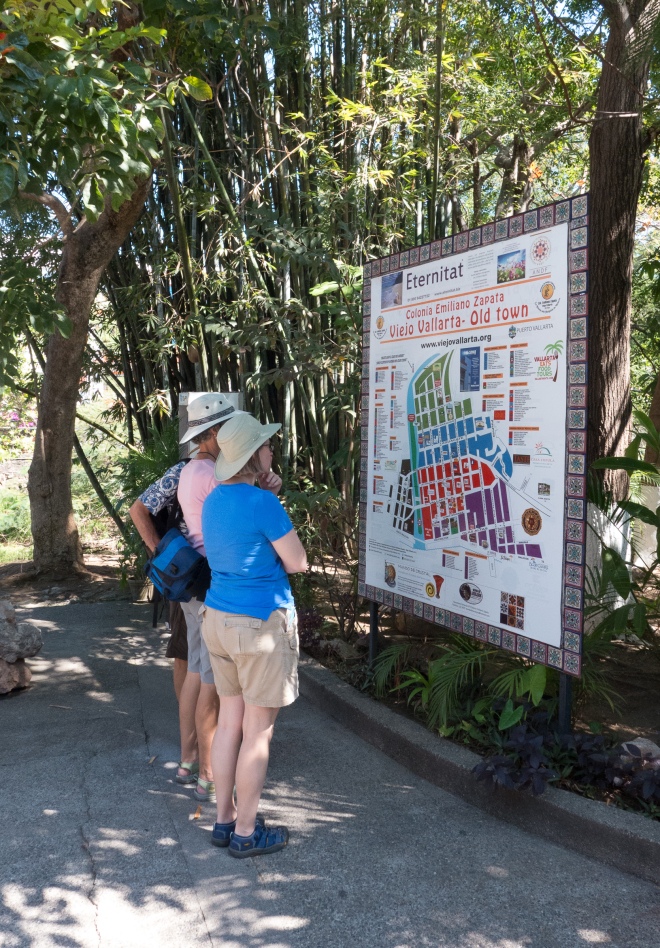
Helpful maps kept us from getting lost.

PV_Map

lush_beach
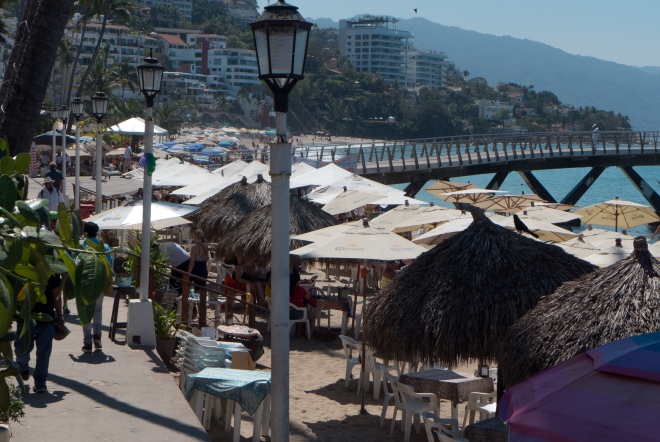
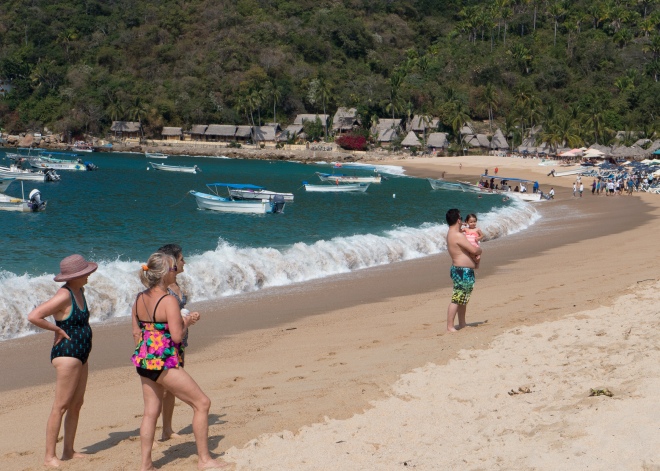
The beach was full of tourists.

We also sailed on Velic from Puerto Vallarta to Yelapa. Yelapa is a small town on the southern side of Banderas Bay that is only accessible by boat.

Yalapa
Approaching Yelapa.
Velic
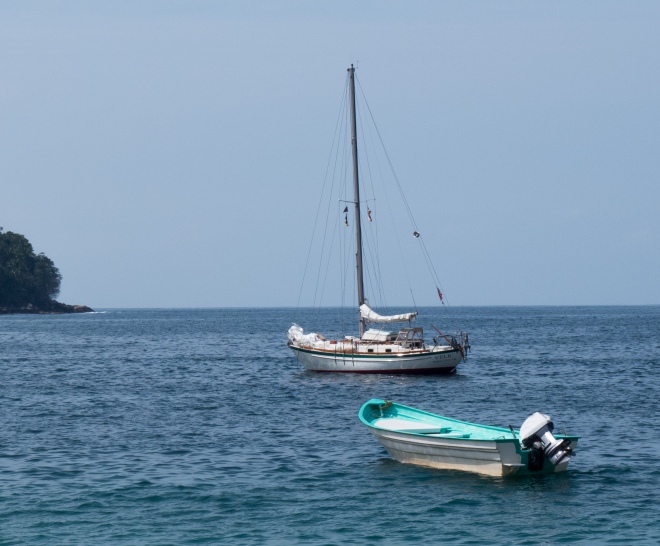
Velic moored at Yelapa.

As we approached Yelapa a panga, a small open fishing boat, came out to Velic and offered us a mooring and water taxi services. After we arrived and got moored the panga took us ashore. We were delivered to the associated restaurant. Once ashore we were shown to our table. The locals do not like to leave anything up to chance. Luckily the food was good.

lunch_beach
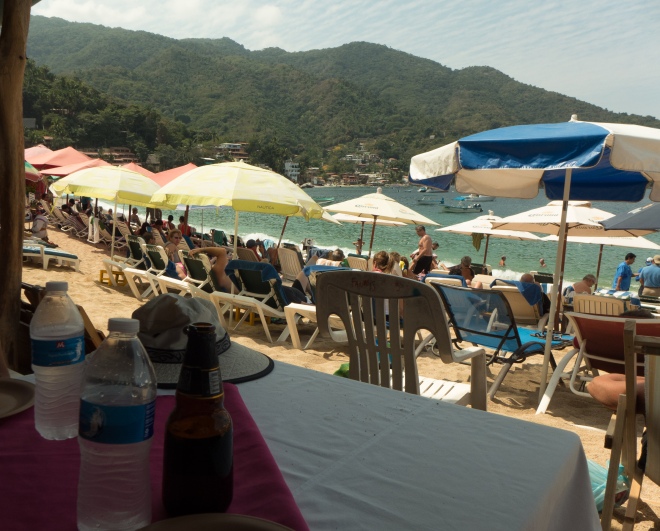
The restaurant beach.

Lunch was a study stream of vendors. We did get some souvenirs.

Yalapa_beach
The surf breaks right at the beach.The beach was made of small gravels. It was hard to walk on with oh so tender northern feet.
Yalapa_street
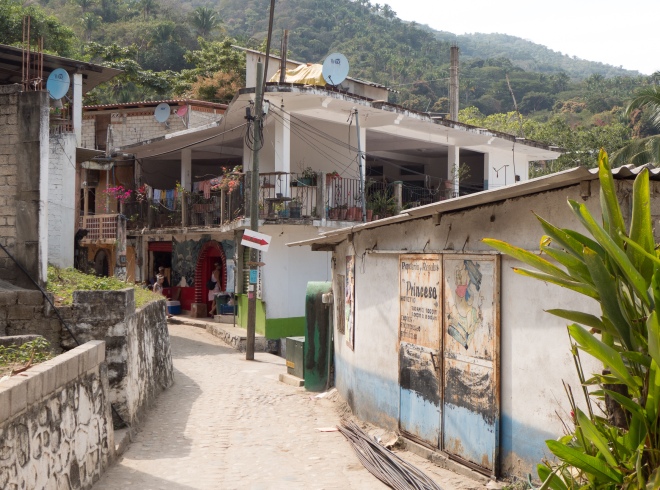
We walked to the town which is up on the hillside.
Yalapa_flowers
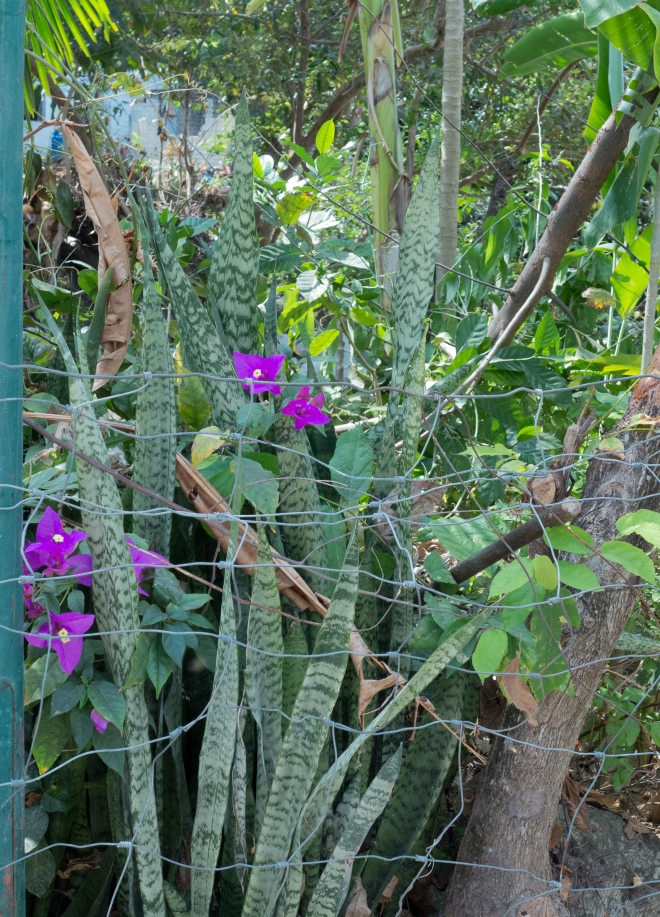
Garden view.
Yalapa_waterfall
Behind the town is a waterfall.

We had a great trip and we came back to rainy cool Portland to once again continue our quest to head off into the wild blue yonder, even if it is hot.

Mid February: Back on the boat

It’s finally getting warmer here in Portland and our thoughts are turning toward insulation.  Not really a sexy subject as temperatures warm up, but the temps were definitely in the range where contact could be made.  We’re using 1/2 inch Armaflex, a type of neoprene, as our insulation.  Nina made brown paper patterns, cut out the foam and we were just waiting for a weekend warm enough to make the contact cement actually work.  Oh, and there was potential for painting, as well! It was a busy weekend.

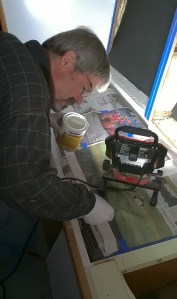
Bill applying contact cement.
Bill applying contact cement to the hull side.  While this was drying, he painted a coat of glue on the foam piece for that locker. We installed over twenty pieces of insulation to different parts of the boat.

Most of the locker insulation has been cut out and installed in the salon and the v-berth.  We still need to figure out the insulation for the ceiling in the salon, the v-berth and anywhere else we will be installing removable panels.

We started working on painting, or at least getting surfaces primed.  The interior has been a mishmash of sanded bits, raw wood and areas needing work for a long time now.  We still have original yellow paint in places.  This is really a strange greeny yellow that would have been perfect on 1950s hospital walls, if they wanted them cheery.  Painting everything a uniform white is lovely.

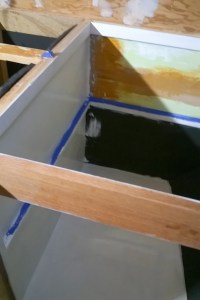
Starboard settee prep.
Starboard settee prep. Once this has all its coats of paint, we can put the settee top back in place.  Bill painted the pieces for this at home.
Lockers with priming.
Lockers with priming.  Looking better already even in bad lighting.
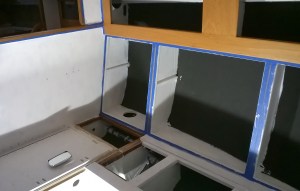
Pantry with primer and insulation on the lower area.
Pantry with primer and insulation on the lower area.  This is getting done in stages.  A shelf will sit where the blue tape is, so we need to get under it finished before it is installed.  There will also be a bulkhead attached to the board going across the top to separate the pantry from the icebox and this will make access to the lower section of the pantry next to impossible once it’s in.


Nautical Historical Fiction

We have not been keeping to our weekly blog schedule and the reason is the cold weather is limiting what we can get done. There just hasn’t been much to report. We needed some ideas for the blog. Well, having day jobs as a librarians means that Nina and I spend a lot of time thinking about books to read and to recommend. We’ve decided to include the occasional book column to provide some variety. Since this is a boating blog it is only natural to recommend some sailing adventures. Now is a great time to curl up in a chair and imagine the salt spray and the cannons roar. These books should help you to make it to spring. I hope you will enjoy some of them.

I am a fan of C. S. Forester’s Horatio Hornblower series and Patrick O’Brian’s Aubrey/Maturin books, that means I like historical nautical fiction. Forester and O’Brian represent the two poles of this genre, (genre: a specific subcategory of fiction). While there were earlier naval fiction books dealing with life aboard naval ships and battles at sea, Forester defined the genre with the Horatio Hornblower books: they were action packed page turners that always turned out well for Hornblower. Maybe they were a bit shallow, but they were thrilling. Book one is Mr. Midshipman Hornblower. On the other hand there are the O’Brian Aubrey/Maturin books. They are slower paced, and literary. They have character development, science and and a sense of place as well as thrilling battles. Start with Master and Commander. Both of these series are great and they will give you hours of reading enjoyment. The real question is what to read next? Well, there are lots of other choices. I am going to start with the newest options first and work back.

Most of the nautical historical fiction books have been about English sailors in the Napoleonic Wars. One change in the recent books is they are about different times and navies. First books in the series are listed. Let’s start with J. D. Davies’ series The Journals of Mathew Quinton. In Gentleman Captain, (published in 2010), the time is 1662 and Charles the II is on the throne. Quinton’s first command sank out from under him and the king has given him a new ship to sail to Scotland to fight the rebels. Will he mend his reputation? If you like O’Brian, you should enjoy this series.

Richard Woodman’s Kit Faulkiner naval adventure is set even earlier, in 1618, during the English Civil War. Kit starts out as a 12 year old boy on a merchant ship. Lots of history and action beginning in A Ship for the King, 2011.

David Donachie’s John Pearce series is set in the familiar English navy fighting Napoleon, but John Pearce is a pressed sailor so you get another view of the navy in By the Mast Divided, 2005.

The Kydd Novels by Julian Stockwin follow the naval career of Thomas Paine Kydd, another pressed sailor. In the first book Kydd , he is a young wig-maker and he has been caught by a press gang and pressed into service as a ordinary seaman. He has to adjust to a completely new life as a sailor on a ship of the line. As you have guessed, if you read enough books, he eventually becomes the captain of his own ship. The setting is the Napoleonic Wars. The series is noted for doing a good job of depicting life aboard a ship in the English navy.

Alexander Kent writes the Richard Bolitho Stories. They stories are fast paced and action packed in the Hornblower mold. Bolitho comes from a naval family so he gets to start his career as a midshipman. The setting is the English Navy during the Napoleonic Wars. The first book is Richard Bolitho, Midshipman.

Close to the same time, but the American Revolution is the setting for William Hammond’s Cutler Family Chronicles. Richard Cutler joins the American Navy to help fight the Revolutionary War. Book one is A Matter of Honor, 2007.

Another series set during the American Revolution is James Nelson’s Isaac Biddlecomb books. Biddlecomb is an American Colonial merchant sailor trying to smuggle goods past the English fleet. He ends up being swept up in the conflict against the English. By Force of Arms is the first book.

Finally, if you like your nautical fiction hero to have a bawdy life ashore then the Alan Lewrie Naval Adventures by Dewey Lambdin are for you. Lewrie gets sent to sea by his family because they want to get rid of him. To his surprise he not only survives, but he likes being in the navy. These books are full of action, both on land and on the sea. You will follow Lewrie from ship to ship and bed to bed. The one thing you can count on is the French won’t catch Lewrie sleeping. Start with The King’s Coat.
Year 2: Week 1 Will it ever end?

Yes, it has been a year since Gypsy was hauled out of the water and put on a truck to start her spa treatment. We have been working away at a frantic pace ever since. The holidays and the cold have slowed us down, but we are still plugging away.  A week ago we added a coat of epoxy filler to fair the joints in the pantry. It took having the space heater next to the area to get the epoxy to cure a day later. We did the lids for the port settee in the garage last weekend the same way.

Bill decided it is too much bother to do epoxy in the cold, so decided to work on the engine instead. We have had a number of deferred maintenance projects on the engine that have been postponed due to other projects. This is a good time to address them since we can’t do much else and they need to get done. Bill read the Yanmar shop manual and got out the wrenches.

The engine is 18 years old and a number of things are due for inspection or refurbishing. We only got to two things last year while the engine was out of Gypsy in Tom’s shop. We installed new engine mounts from PYI. Tom also made a new mount for our Balmar alternator.

Here is a list of what still needs to get done:

Starter motor rebuild: this is a bit of preventative maintenance.

Fuel injector rebuild. Yanmar suggests rebuilding at 1000 hours. Ours have about 1200 hours on them. We took them to Pacific Fuel Injection in Portland and they said that the injectors were well below spec. The moral is that deferring injector service is not doing your engine any favors.

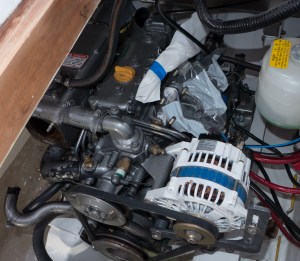
Plastic bags are great.
Plastic bags are great keeping dust out of the places where parts were removed.

Heat exchanger inspection. On our last trip north we discovered that the front cover for the heat exchanger was leaking. We had this neat salt stalactite on our engine so we used permatex to seal things up.  Once we were home, we would take care of it.  Well, a number of years have passed and it is finally time. The good news is since Gypsy spends her time in fresh water her cooling system is not all corroded. New gaskets and seals are coming from Cook Engine.

Heat exchanger removed.

The exhaust elbow was also pulled to see if it was corroded or plugged up with carbon. It is in pretty good shape so it goes back on with a new gasket.

While the engine is torn apart we are going to replace all of the hoses.  They are also on order.

Our Yanmar has been very reliable and a bit of service is a small price to pay to keep it working.

Meanwhile, Nina has been working on more insulation patterns and cutting out the pieces.


A new year, some ideas

It has been cold in Portland and you could say that that helps to create a holiday spirit. You could also just say it has been cold. Cold defined as we can’t paint and the epoxy won’t set. Well what do we do when it is too cold to work on Gypsy? We plan and we dream. The planning part deals with reading about boat wiring and designing a refrigeration system. This is not very exciting but it must get done, so now is a good time.

The dreaming part is more fun. It involves learning Spanish and planning a trip to Mexico to see friends this winter. We also are keeping up with our favorite blogs and we thought we would share them with you. These blogs are important because they inspire us and they give us ideas. To all of you blogging, thank you. All it takes is something to latch on to and we can make it through another day at work.

Twice in a Lifetime is about the crew of Galactic, Mike, Alicia, Elias and Eric. They left Kodiak,, Alaska when Elias was a baby and they have been cruising since 2007. They spent last year in Patagonia and now they are in the Falklands. Better yet they are reading the Swallows and Amazons books while they cruise! They keep going places and doing things I want to do.

When you are rebuilding your boat you want to commiserate so we read Matt and Jessica’s sailing page. They are rebuilding an aluminum sailboat while they live aboard. This helps us feel better since we don’t live aboard while we rebuild.

We would not have know about Matt and Jessica if we weren’t following Ellen and her Cynical Sailor & His Salty Sidekick.  Ellen’s sister is a library coworker:  it’s a small world, and Ellen has cruised New Zealand and now Florida. She is always fun to read. In fact Nancy Drew helps her fix leaks on her new boat.
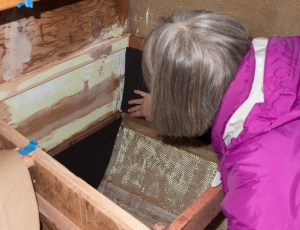
When good friends set off cruising, it is an inspiration for us to finish the boat and take off on our own adventure. Sailing on Velic is their tale of adventure. So far it has been Portland to Mexico, but stay tuned and follow them around the world.

This blog has helped us to meet sailors from around the globe. I have enjoyed Viki’s blog, Astrolabe Sailing. She is in New Zealand and when it is winter in Portland it is summer in New Zealand so I can read about sailing adventures there.

These blogs cover a range of sailing from being in one place to the very adventurous. I think it is good to have a range so I stay aware of what is possible while realizing that anytime you are messing around in a boat it is good.

Bill


Week 49: and that makes a year.

Along with short days and too much food, now is the time we take stock and try to make sense of the past year. One of the reasons we started this blog was to track our progress as we work on Gypsy so we would not forget what we’ve done.

It has been a mammoth project and it has had its woolly parts.  Our friends keep asking us when we are going sailing and we have to remind them that there is a bit more to do. Our friends are right in insisting that the goal is to go sailing. If we just wanted to stay busy we could take up gardening. Here is a recap of the year.

cropped-blogheader.jpg
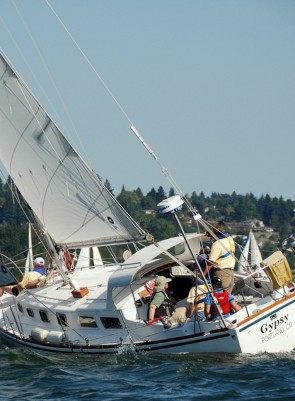
This is what Gypsy used to look like. She has always been fun to sail.
Gypsy
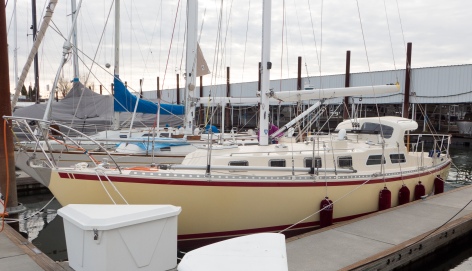
Gypsy looks a lot better, but we have yet to bury the rail.
Cabin_settee_and_table.jpg
The gold shag carpet hull covering is gone, so is the bulkhead heater.
glued_in_III
Someday there will be proper insulation, a ceiling and an Espar furnace to keep us warm.

Of course there is a bit more to do. We have started looking at upholstery, wish us luck.

We have been making plywood parts at home that we will install when it gets warmer. Nina has been busy making winch covers with her new sewing machine. I think she likes her Sailrite.

winch_cover_
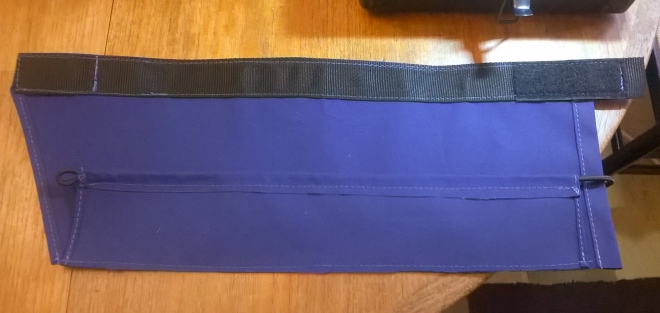
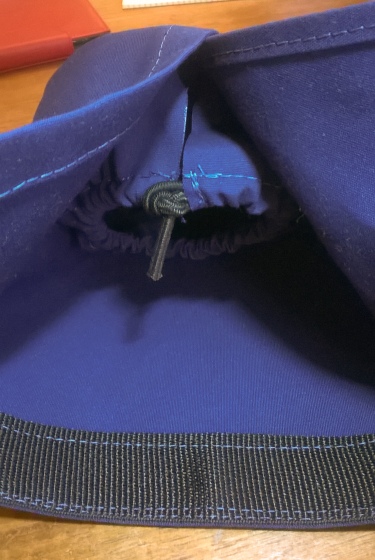
Winch cover started
winch_cover__II
Detail of elastic bit to go around the top of the winch.
Nina_I
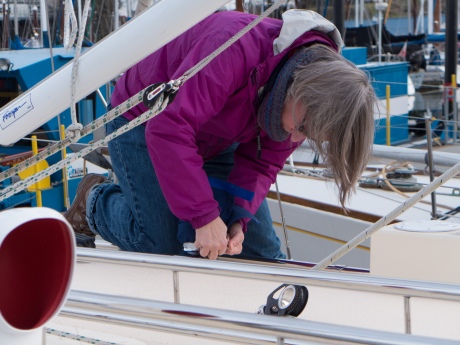
Installing.  This one was too tight, so Nina ripped it apart and make it fit better.  The new version fits, but it was installed in the dark, so no photo.
winch_cover__V
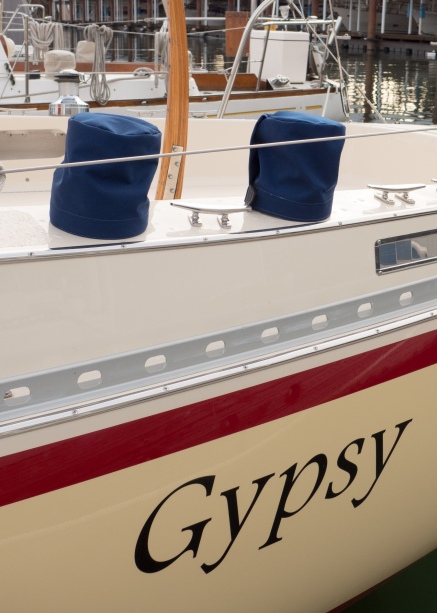
I think the color, Sunbrella Marine Blue, compliments the paint scheme.

So that is the latest on Gypsy. Have a Happy New Year and we will keep bringing you updates on Gypsy.

Week 45, 46 & 47: All I want for Christmas…

Three weeks.  What do we have to show for ourselves?

Well, in our defense, it’s been cold and rainy and wet and it gets dark early. (Plus we are supposed to be Christmas shopping. We tried that yesterday, we went to the mall, and Bill will honestly say that we would both prefer to sand fiberglass).  All this conspires to make it difficult to a) epoxy things to the boat, b) paint anything on the boat, and c) stay warm enough to really get a lot done and d) actually see what you are working on.  We’re also to the point in the project where it makes sense to sit and think about how we want to build things.  And to realize how many pieces rely on having the pantry, icebox and galley built.

Epoxying the pantry cleats in place.

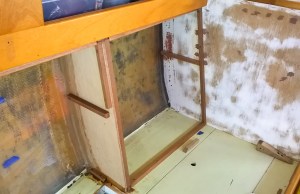
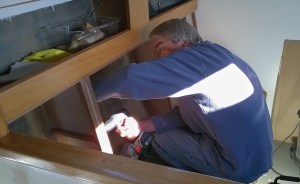
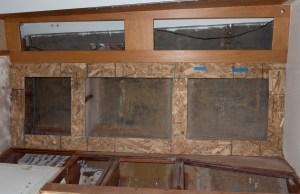
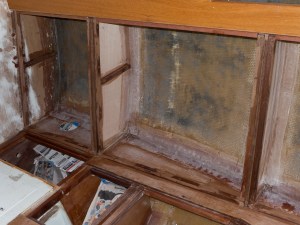
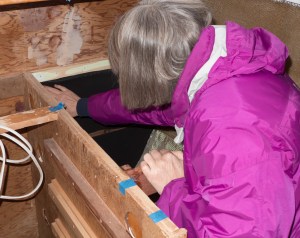
The last post was focused on the settees.  They are pretty much in place, and while Bill worked on figuring out where cleats in the galley would go to support shelves and bulkheads, Nina started working on making patterns for insulating all the compartments we’ve created.  Our little space heater keeps the boat almost warm enough for epoxy to kick.  The almost warm air also creates condensation on any surface below the waterline.  We’re using 1/2 inch Armaflex for insulating the hull sides.  To make sure it will fit, Nina has been making brown paper patterns.  Dry fitting takes on a whole new meaning when every surface has to be dried off before anything can be fit.  Most of the salon is done, at least as far as lockers go.  Cutting out the Armaflex is easy to do with a pair of scissors, and the dry fit of all the pieces went well.  We’ll be covering the Armaflex with vinyl.  Here’s what fitting the pantry looked like, and yes, the coat was needed.

insulation_1 insulation_2 insulation_3 insulation_4

We need to trim off material where the pantry shelves will go, otherwise it fits nicely.  All we need is a dry, warm weekend…

Meanwhile, we are getting some epoxy coating done at home.  The starboard settee lid over the water tank is about ready to install.

Bill’s also been working on how to build the icebox.  He built a cardboard mock-up a while back, and now needs to decide how to build it.  Do we fit the foam in place first and then glass in a box, or do we build a box and then install foam around it?  There’s also the question of the lid and how we want to do that.  Much to ponder while we wait for the days to start getting longer.
Week 43 & 44: It takes two weeks worth of fun to make one post

You should never skip a week when you are blogging. The main reason for this is it is really hard to remember back two weeks, two days is hard enough. So apologies for taking a week off from the blog, but we kept on working on Gypsy.

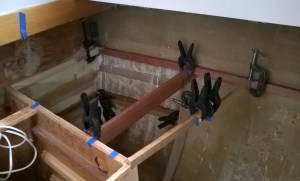
We started by tabbing in the settee backrest bulkheads and the refrigerator and pantry floor and bulkhead. This was followed by making all of the cleats to locate the plywood faces of the settee backrests and the shelves in them. This sounds easy but it involves cutting lots of pieces of wood, and the shelves required a fair amount of thinking about how they would work. We even brought camera bags, wine bottles and plastic containers down to try out storage ideas and to see how things would fit.
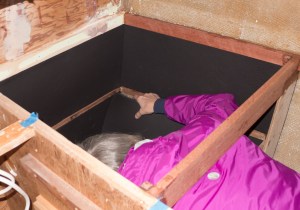
Cleats for the shelves and the face of the settee backs.
Bill installing cleats.

Once the cleats were done and before we got everything gooped with epoxy we made the templates for the plywood fronts. We removed all of the cleats and sanded away any paint that was in the way. All of the cleats went back in one last time, epoxied in place.

Template for the plywood face.
Cleats are glued in.

It has gotten cold in Portland and with the temperatures in the mid 40s it was taxing our space heater to keep the boat warm while we worked and the epoxy cured. We will have to start looking at projects that do not need warm temperatures for the next couple of months.